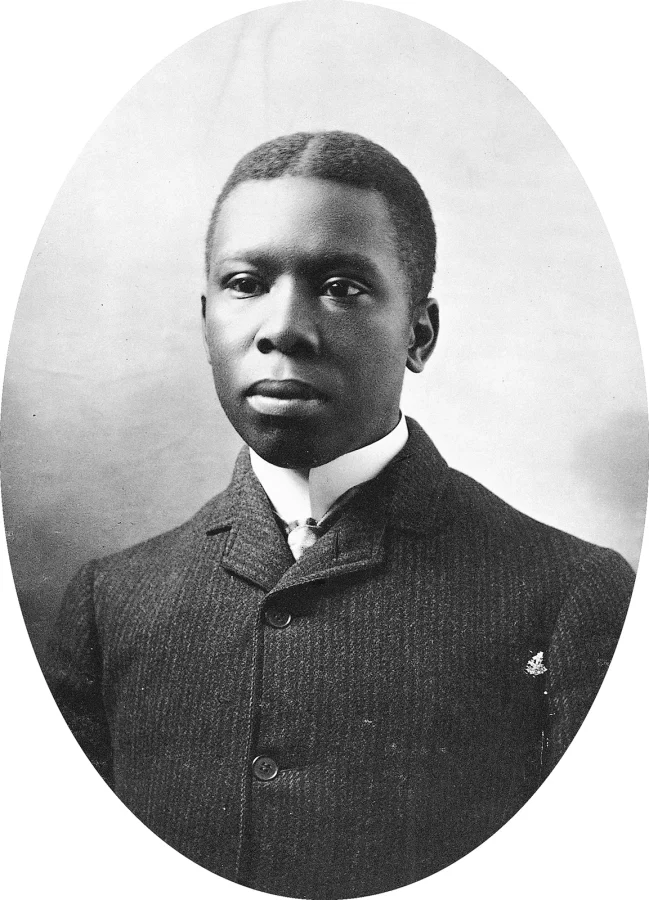
There are writers who impress and inspire me, but near the top of my list is poet, novelist, and short story writer Paul Laurence Dunbar. He was a writer who accomplished more in his short life than most writers do in a lifetime. Over the course of his 33 years, he wrote 600 poems, 12 books of poetry, five novels, four volumes of short stories, several essays, hundreds of newspaper articles, and even lyrics for musicals.
Calling him prolific is an understatement.
Dunbar was the son of freed slaves who got his start in his hometown of Dayton, Ohio. At sixteen he published his first handful of poems in the local newspaper while also serving as president of his high school literary society. Keep in mind, he was the only African-American student in his school, yet he was accepted and respected for both his personality and his intelligence.
Two years later, he wrote and edited the city’s first weekly African-American newspaper, The Tattler, which was published by his high school friends, Wilbur and Orville Wright (you may have heard of them!). Although it only had a short run, it was the beginning of Dunbar’s writing career.
He was soon recognized and supported by patrons of the arts, and quickly became associated with Black leaders Frederick Douglass and Booker T. Washington. Also, his work was reviewed in publications such as Harper’s Weekly, which brought him national attention.
One of the things that set Dunbar apart from his contemporaries is that he wrote not only in conventional English, but also African-American and regional dialects. He felt that writing only in African-American dialect was pandering, doing what was expected. But the variety of voices he used allowed his work to reach a broader audience.
Dunbar was the first African-American poet to receive national recognition and the New York Times wrote that Dunbar was “a true singer of the people – white or black.”
But what he should be remembered for is for writing one of the most iconic lines in African-American literature. From his poem, “Sympathy”:
“… When his wing is bruised and his bosom sore, When he beats his bars and he would be free; It is not a carol of joy or glee, But a prayer that he sends from his heart’s deep core, But a plea, that upward to Heaven he flings – I know why the caged bird sings!”
 Unfortunately, Dunbar was diagnosed with tuberculosis and succumbed to the disease in 1906. It probably didn’t help that he was prescribed whiskey as a form of treatment.
There’s so much more I could write about this man who died far too young, but I think his works can speak for themselves. Dunbar’s works are now in the public domain and many of his poems and stories can be found at Project Gutenberg.
Please take the time to read a few of his poems or stories. He was a wonderful writer and left an amazing literary legacy.
RB
I didn’t know Paul Laurence Dunbar and I thank you very much for having talked about him.
So happy to hear that, Luisa. Thank you for commenting. 🙂
You’re more than welcome 💙🙏💙
Not heard of him either but I’m going to look out for him. Thank you Richard
Glad to hear that, Sheree!
Fascinating history of a remarkable African American writer who transcende race and time. I was particularly interested in his connection to the Wright brother and how a line in his poem was the impetus for Maya Angelou’s poem and book.
Oh, yes, he had such an interesting – albeit short – life and his work is timeless. Thanks for commenting, Pat.
Hi. I’ve never read anything by him. And I’m not sure if I even heard of him before. Thanks for bringing him to my attention.
So glad to hear that, mate! Hope you get an opportunity to check out some of his poems. Thanks for commenting!