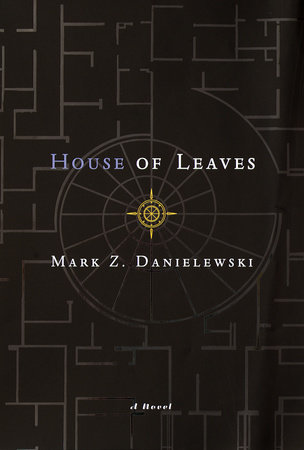

I was expecting a fairly straightforward horror story when I picked up a copy of House of Leaves by Mark Z. Danielewski. What I got, however, was something completely different from any other fiction novel I’ve read. The story itself is hard to describe in a few words. It’s a bit of horror, love story, dissection of literary tropes, and jigsaw puzzle.
The basic premise is a young man discovers the papers of a deceased blind man that go into great detail about a documentary film, The Navidson Record, that may or may not exist. The film follows a family that moves into a new home and soon discovers that it is larger on the inside than the outside. In fact, a hallway opens up in their living room that leads to an endless labyrinth of halls, doors, stairs, and enormous rooms. To make things even more bizarre, the configuration changes at random moments, walls expand, floors fall away, and stairways shrink and lengthen.
As a straight horror premise it would be interesting reading. However, Danielweski takes a different narrative approach which makes reading the story both intriguing and challenging. 
This is a story within a story. The protagonist, Johnny Truant, tells the reader his story about finding the papers and the effect it has on him while at the same time lays out the story of the mysterious house, as told in the dead man’s notes. There are also dozens and dozens of footnotes – some real and some fictional – from both Truant and the “book editors”, as well as several appendixes.
 I don’t want to forget to mention there are also strikethroughs, empty pages, and other pages where text runs down the margins, is written backward, or is scattered as if dropped randomly on the paper. Several sections even require the reader to turn the book on its side or upside down to read the text, or to backtrack and skip forward. I’ve added a few random photos as examples of what a reader can expect from House of Leaves.
 This all blurs the line between fact and fiction and creates an interesting and challenging reading experience. What is real in this story? What is hallucination? It almost feels as if Danielweski is taking pokes at academics who pick apart the minutia of novels. There’s a lot to take in here and the story requires the reader to take their time and pay attention to everything.
So, did I enjoy reading this book? Yes, for the most part. I wasn’t sure what I was getting into when I started and it took me a chapter or two before I began to get into the chaos of the narrative. Note that the narrative becomes more chaotic as the story progresses, which matches what is happening in the story. Both stories, actually.
I won’t recommend this book to the casual reader. It’s far too messy and complicated for summertime beach reading. But if you’re interested in reading something that challenges you, makes you pause and think, and keeps you wondering what exactly it going on, then by all means pick up a copy. In the end, I did find it fun and it gave me a new appreciation for creative narration.
RB
Mmmm, sounds interesting but…….
Completely understandable, Sheree! It’s definitely not for everyone.
Thanks Richard
My book app only provides a summary of the book, so I’ll give that a go and see if I can follow 😄 I am always up for a challenge though !
Good luck! It’ll be unlike anything you’ve read before.
A very thorough review. I will take on the challenge when I get my brain back in gear. 😄
Thank you, my friend. Hope you find it as interesting and challenging as I did.
Quite the book, you have shared here, Richard. Impressive review.
Thank you, Pat. It was quite a challenge.
Thanks a lot for sharing this great review and your observations on the book!
And thank you, Luisa, for stopping by to read it! 🙂
You’re most welcome ❣️🙏